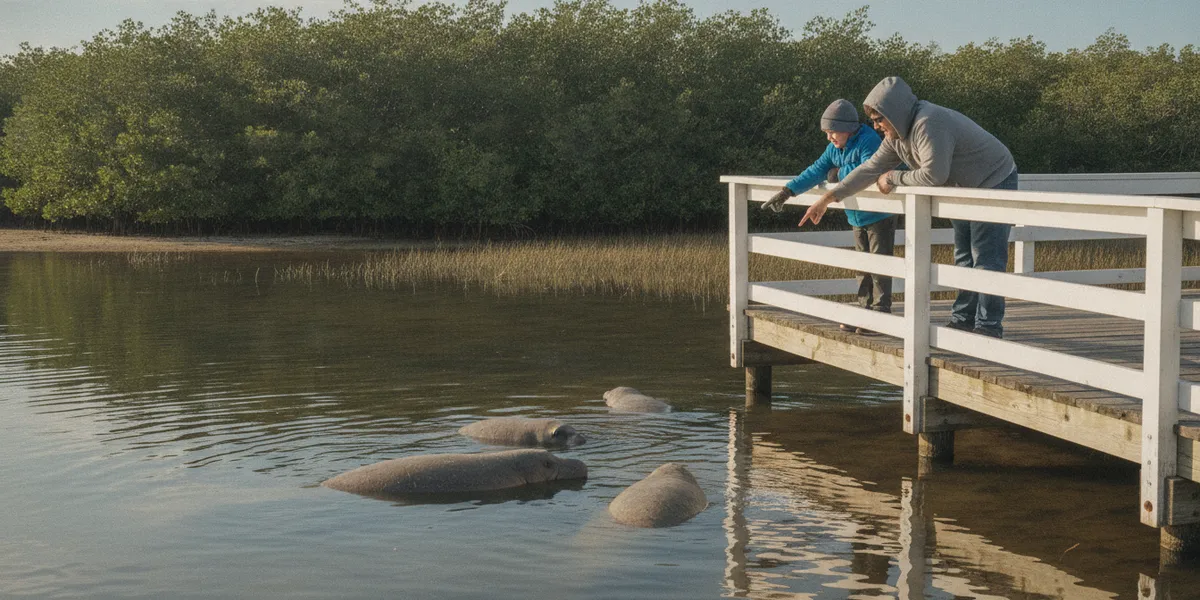
On a cold January morning, the canal behind Tampa Electric's Big Bend Power Station looks like it's full of floating gray boulders. Then one of them exhales.
That's the whole appeal of the Manatee Viewing Center in Apollo Beach. When Tampa Bay gets chilly, manatees crowd into the warm, clean water the power plant releases, and you can stand on a boardwalk a few feet above them. It's free, it's 30 minutes from downtown Tampa, and it's one of the few wildlife outings where "will we actually see anything?" usually gets a yes.
This is the planning page for that one place. For other spots to see manatees around the bay, see our broader Tampa Bay manatee guide.
Quick facts
| Detail | Info |
|---|---|
| Address | 6990 Dickman Rd, Apollo Beach, FL 33572 |
| Season | November 1 – April 15 (2026-27 season opens Nov 1, 2026) |
| Hours | 10 a.m. – 5 p.m. daily; trails and tower close at 4 p.m. |
| Closed | Thanksgiving, Christmas Day, Easter; closes 3 p.m. Christmas Eve |
| Admission | Free |
| Parking | Free, with overflow parking just south of the center |
| Pets | Not allowed (service animals welcome) |
| Phone | 813-228-4289 |
| Time needed | 1–2 hours |
Details come from Tampa Electric's Manatee Viewing Center page. Check it the morning you go, since the center occasionally closes for weather.
When to go (this matters more than anything else)
Manatees don't live here. They visit when the bay gets cold, because they can't handle water much below 68°F for long. The power plant's discharge canal stays warm, so on cold days it fills up.
That means:
- December through February is the sweet spot.
- The morning after a cold front is the best single day you can pick. Watch the forecast for a night in the 40s or low 50s.
- November and early April can be hit or miss. On a warm day you might see a handful, or none.
- Mid-April through October the center is closed. Don't drive down.
Here's the thing most first-timers get wrong: a sunny, 80-degree Saturday in March feels like perfect outing weather, and it's often the worst day for manatees. Cold and gray beats warm and pretty.
You can check before you leave. The center runs two webcams (East and West) during the open season, so you can see whether the canal is busy before you load the car.
What's there besides manatees
The manatees are the headliner, but kids who get bored of "gray blob, gray blob, oh look, a nose" have other things to do.
The viewing platform and tidal walk
The main boardwalk overlooks the discharge canal. The tidal walk is a 900-foot, ADA-compliant walkway through native coastal plants, and it ends at another manatee viewing spot. Strollers and wheelchairs work fine.
Cownose ray touch tank
This is the part younger kids remember. There's a cownose ray habitat where the rays glide past close enough to brush your fingertips. Follow the staff's instructions on how to touch (two fingers, gently), and it's a calm, easy win for preschoolers.
Environmental education building
Indoors, kids can handle real manatee bones, do puzzles, walk through a mangrove tunnel display, and learn about individual local manatees and the threats they face, like boat strikes. It's a good 15-minute break from the sun.
Habitat trail and 50-foot observation tower
Halfway along the habitat trail, a boardwalk leads to a 50-foot wildlife observation tower. On a clear day you can see across Tampa Bay. There are picnic tables at the base of the tower and shaded solar tables along the trail (yes, you can charge your phone). The trails and tower close at 4 p.m., an hour before the center does, so do this part first if you're arriving after lunch.
Florida Conservation and Technology Center
The viewing center is part of a larger campus called the Florida Conservation and Technology Center. A golf cart shuttle runs to the conservation center; the last one goes at 4:30 p.m.
Getting there from Tampa
The center sits on Dickman Road off Big Bend Road in Apollo Beach, roughly 30 minutes south of downtown Tampa via I-75 or US-41, depending on traffic. From Brandon or Riverview it's closer to 20 minutes.
Tampa Electric specifically tells visitors to use Big Bend Road to reach the center. Follow that rather than whatever shortcut your map app invents.
On a cold weekend in January, the lot fills. Get there right at 10 a.m. or come on a weekday. Overflow parking is just south of the center.
Tips for visiting with kids
Set expectations for toddlers. A 2-year-old may care more about the rays or the gift shop than the manatees. That's fine. Plan 45 minutes and leave happy.
Bring binoculars for ages 5 and up. Manatees mostly show their backs and snouts. Binoculars turn "I think that's one" into "that one has a scar on its tail."
Teach the scar thing. Many manatees have propeller scars. It's a sad fact, but kids grasp it quickly, and it makes the conservation exhibits land.
Wear real shoes. The center asks for shirts and shoes, and recommends closed-toe shoes. It's open rain or shine.
Pack a picnic. There's no restaurant on site, and the picnic tables by the tower are a nice spot. Apollo Beach has plenty of casual food nearby if you'd rather eat out.
No drones, no dogs. Both are prohibited. Photos for personal use are fine.
Make it a half-day
The viewing center pairs well with a few other south-county stops:
- E.G. Simmons Park in Ruskin for a picnic and a walk by the water.
- Apollo Beach Nature Preserve for a short beach walk.
- Head back north for lunch and a Tampa Riverwalk stroll.
If your kids fall hard for manatees, the next level is a day trip to Crystal River or Homosassa, where you can see them underwater. We cover those in our guide to springs near Tampa.
Is it worth it?
On a cold day, easily. It costs nothing, it takes a couple of hours, and your kids will see dozens of large wild animals up close with no boat, no tickets, and no gamble on a tour.
On a warm day in late March, it's a nice boardwalk with a ray tank. Still fine, just temper expectations. Check the webcam first.
For more no-cost ideas, see our list of free things to do in Tampa with kids, or browse more family activities in Tampa.