What Age Should Kids Start Piano?
Many children can start piano at age 4, but the birthday alone does not decide readiness. A 3-year-old may thrive in a playful, parent-supported class, while another child may enjoy music more by waiting until 5 or 6. Look for interest in the instrument, willingness to copy a simple rhythm, and comfort joining a brief guided activity with an adult.
The American Academy of Pediatrics does not set a piano starting age. Its HealthyChildren.org guidance on learning through play says attention commonly begins to lengthen around ages 3 and 4, although preschoolers may still need adult help to begin or stay with an activity. That supports short, supported lessons. It does not create a required attention span or guarantee that a child is ready.
For Tampa parents comparing piano lessons for 4 year olds, start with the program's stated age, format, and parent expectations. Then ask the teacher how the lesson changes for young students.
Tampa Bay Piano Lessons for Ages 3-5 and Published Prices
Every program below states on its own website that it accepts at least one age from 3 through 5 and publishes a price. Prices buy different lesson lengths and enrollment periods. Each price is listed as checked October 24, 2026. Confirm before booking because schedules, openings, and tuition can change.
| Area | Provider and program | Ages | Format | Published price |
|---|---|---|---|---|
| South Tampa | Grosso Music & Fine Arts Preschool Piano Party | Pre-K age 4 through kindergarten ages 5-6 | Weekly 45-minute group at Bayshore Baptist Church | Lists $125 per month for eight months, plus a $75 annual registration fee (checked October 24, 2026); confirm before booking |
| Carrollwood | Academy of Musical Arts | Private lessons start at 3; trial package is for ages 3-5 | Four 30-minute private trial lessons | Lists $137 for the four-lesson trial package (checked October 24, 2026); confirm before booking |
| Lutz and Land O' Lakes | Hudson Music Studio | Preschool piano ages 3-4 | Weekly 30-minute private lesson recommended for this age; studio, in-home, or online | Lists $150 per month for weekly 30-minute lessons (checked October 24, 2026); confirm before booking |
| Tampa Bay, location arranged with studio | Tinatin's Piano Studio | Starts at age 4 | Four 30-minute private lessons per month | Lists $150 per month (checked October 24, 2026); confirm the lesson location before booking |
| St. Petersburg | Music & Me Mini Keys | Ages 3-5 | Four-child, 45-minute group with keyboard, drumming, movement, and games | Lists $112.90 for the September 9-November 11, 2026 session (checked October 24, 2026); confirm a future session before booking |
Hudson lists in-home service in Westchase, Wesley Chapel, South Tampa, Brandon, and Riverview, but travel availability still depends on teacher scheduling. Music & Me's posted Mini Keys session was nearly full when reviewed. An old session price is useful for comparison, not proof that a seat remains.
We did not find a qualifying Clearwater studio that published both a preschool age and a current price on its own site. Jil's Piano Studio states that it accepts age 4, but it does not publish tuition. We left out providers whose age, price, location, or preschool format could not be confirmed.
What the Local Programs Actually Teach
Grosso Music & Fine Arts: Piano Party begins with rhythm, finger numbers, and finding a path around the keyboard. The school places children in a group at Bayshore Baptist Church in South Tampa. The eight-month commitment makes the cancellation and make-up policies worth reading before registration.
Academy of Musical Arts: This Carrollwood studio specializes in early-childhood private instruction and offers a defined four-lesson trial for ages 3-5. The trial creates a useful decision point: ask what the teacher observed about focus, enjoyment, and home participation before moving into regular tuition.
Hudson Music Studio: Its preschool category is piano-only for ages 3-4, with playful exploration and simple songs. Families can attend in Lutz or Land O' Lakes, request in-home lessons where available, or learn online. Confirm whether the same teacher and monthly price apply to your preferred format and ZIP code.
Tinatin's Piano Studio: The studio accepts students from age 4 and describes its 30-minute plan as a weekly private lesson for younger beginners. Its page identifies the service area as Tampa Bay but does not publish a street address, so confirm whether lessons are in a studio, your home, or online before paying.
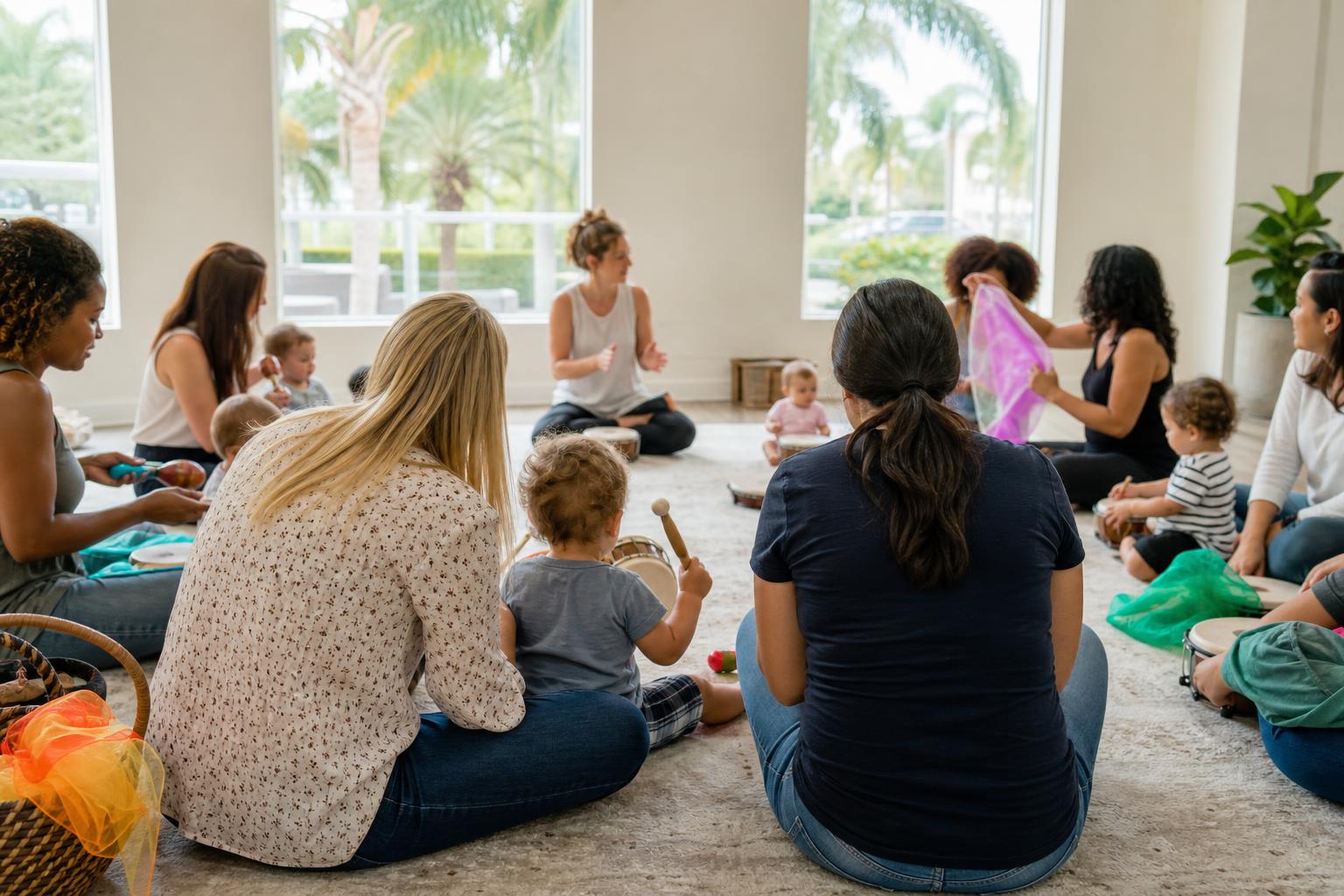
Music & Me: Mini Keys sits between general early-childhood music and private instrument study. Four children alternate keyboard work with djembe rhythm, movement, and musical games. The listed St. Petersburg session includes books and emailed materials, but families seeking piano-only instruction should understand that the keyboard is one part of the class.
Comparing the Real Cost
A monthly number does not tell the whole story. Grosso lists eight months of tuition plus registration. Hudson and Tinatin list monthly private plans. Academy lists a four-lesson trial rather than regular tuition, and Music & Me lists one 10-week session. Ask for the total due through the first reasonable stopping point, including books and fees. That gives you a fair comparison without pretending a group class and a private lesson are the same product.
Is Your Preschooler Ready for Piano?
Treat these as practical questions for a first conversation with a teacher, not medical milestones:
- Does your child choose to explore a piano or keyboard more than once?
- Can they copy two or three claps, taps, or finger movements?
- Will they follow one simple direction during a song or game?
- Can they separate from another activity without becoming distressed every time?
- Will an adult attend and help repeat the activity at home?
A child does not need to read words, identify every letter, or sit still for 30 minutes. Preschool piano often includes songs, floor games, movement, and rhythm away from the bench. Small hands are not a barrier by themselves because a skilled piano teacher can use single notes, black-key patterns, and whole-arm movement before asking for independent finger technique.
Interest can also change. If several lessons bring tears, refusal, or dread, ask the teacher to shorten the task, change the format, or pause. A break does not close the door on beginner piano later.
Piano at Age 3, Age 4, and Age 5
Piano at Age 3
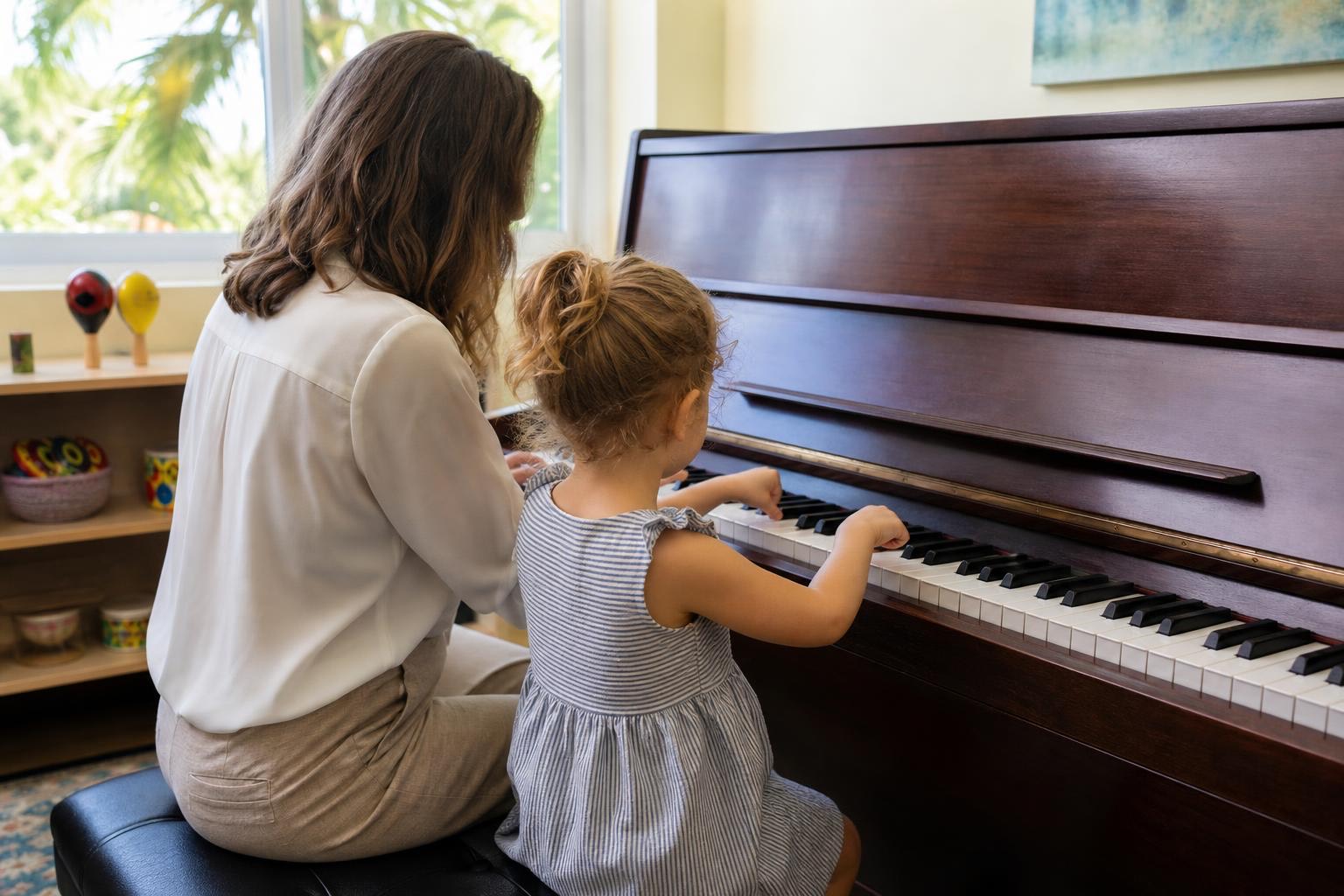
For many 3-year-olds, preschool piano or a caregiver-and-child music class fits better than a traditional method book. Choose a teacher who expects an adult to stay, shifts between activities, and treats keyboard exploration as one part of the lesson. Academy of Musical Arts, Hudson Music Studio, and Music & Me explicitly serve this age in different formats.
Piano at Age 4
Many 4-year-olds can start either a preschool group or short private lessons. This age has the broadest local choice in the table. Match the format to the child: a social child may enjoy group keyboard games, while a child who gets overwhelmed in a group may do better one-on-one.
Piano at Age 5
At age 5, some children are ready for more music reading and a steady weekly assignment. Others still learn better through movement and listening. Ask whether the studio moves children into a traditional beginner piano book automatically or after the teacher sees consistent readiness.
Compare Preschool Piano Approaches
Suzuki Piano
The Suzuki approach begins with listening and learning by ear before emphasizing music reading. The Suzuki Association of the Americas describes frequent listening and an adult learning alongside the child as central parts of the method. Formal instruction may begin around age 3 or 4, but Suzuki does not claim that every child must begin then. This approach suits a family willing to attend lessons and make listening and practice part of the daily routine.
Preschool Piano Programs
A preschool curriculum mixes keyboard time with singing, rhythm, movement, and games. Let's Play Music starts its core program at ages 4, 5, or 6; first-year classes run 45 minutes in groups. Musikgarten separates its music-and-movement sequence for ages 4-6 from later keyboard instruction. Do not assume every preschool music class includes piano.
Grosso's Piano Party and Music & Me's Mini Keys are local examples of group programs with keyboard instruction. They are not advertised as Let's Play Music or Musikgarten classes.
Traditional Private Lessons
Private lessons give the teacher room to adjust the pace, repertoire, and games for one child. They also cost more than some groups and can feel intense if the teacher usually works with older beginners. Ask how much of a preschool lesson happens away from the bench and whether the parent should sit in.
Group Keyboard Classes
A group lets children learn by watching peers, taking turns, and playing rhythm games together. Check class size and whether every child has regular keyboard access. A group can frustrate a child who needs a much faster or slower pace, so ask how the instructor handles different levels.
How Long Should Lessons Be?
The verified local options use 30-minute private lessons or 45-minute group classes. That does not mean a child spends the entire period playing keys. A strong early lesson changes tasks before focus slips, with brief turns for listening, rhythm, movement, and keyboard work. Ask what the teacher does if a child finishes the planned keyboard task early.
A longer group class can still suit a preschooler because children rotate through activities and learn by watching each other. Private time feels more concentrated, so 30 minutes may contain more direct instruction than a 45-minute group. Choose by lesson design rather than the clock alone.
Practice Should Start Small
Try five minutes on most days, or use the exact plan the teacher gives you. Repeat one short song, one rhythm, and one pattern. End while your child still wants another turn. Two calm minutes count more than a 15-minute argument.
Build practice into an existing transition, such as after breakfast or before the bedtime story, instead of waiting for an open stretch. Keep the assignment visible. If the teacher sends several tasks, choose one or two rather than rushing through every item.
The adult manages the schedule, opens the assignment, and notices what needs clarification. For Suzuki study, the parent should attend and learn how to guide practice. In another private or group program, parent participation may differ, so get the rule before enrollment. Send the teacher a question when the same task causes friction on several days rather than teaching a new version at home.
Home Piano or Keyboard Basics
Ask the teacher what the curriculum requires before shopping. You do not need product rankings or a concert grand for a first preschool lesson.
- Stable setup: Put the instrument on a firm stand, not a bed or floor. Adjust the bench and add a foot support so legs do not dangle.
- Full-size keys: Standard-width keys make it easier to transfer skills to the teacher's piano. A tiny-key toy changes the spacing.
- Touch sensitivity: The sound should respond when a child plays softer or harder.
- Weighted keys: A digital piano with weighted keys feels closer to an acoustic action. Yamaha's guide to weighted keys explains the difference. Treat this as a useful long-term feature, not a reason to delay a preschool trial.
- Range and pedal: An 88-key digital piano gives the full range, while a smaller keyboard may be enough for a teacher-approved introductory program. A sustain pedal becomes useful when assigned; Yamaha's pedal guide explains what it changes.
Keep the keyboard available but protect it from climbing, drinks, and unsupervised button pressing. A quiet corner helps, but easy daily access matters more than a dedicated music room.
Questions to Ask Before Enrolling
- How many 3-, 4-, or 5-year-old beginners do you teach now?
- What happens during a typical lesson besides playing at the keyboard?
- Does an adult attend the lesson, and what should we do during practice?
- What instrument, books, apps, or materials must we have at home?
- Are registration, materials, recital, or make-up fees separate from tuition?
- How do you decide whether a child should continue, change formats, or wait?
A clear answer about preschool teaching matters more than a long performance résumé. Confirm the withdrawal and make-up policies too, especially when tuition covers a semester or several months.
For the first lesson, bring the assigned book, arrive early enough for a bathroom stop, and tell the teacher about any sound or transition sensitivities. Watch how the teacher responds when your child wanders, asks an unrelated question, or plays an unexpected key. Preschoolers will do all three. You are looking for calm redirection and a plan that keeps music enjoyable while still teaching a skill. Afterward, ask your child what felt fun and ask the teacher what to repeat at home.
More Music and Activities Around Tampa Bay
For a wider look at instruments, voice, and local studios, use our guide to kids music lessons in Tampa. Younger siblings may fit the caregiver-and-child options in baby and toddler music classes around Tampa Bay or our broader mommy and me classes guide. Children who prefer movement may enjoy kids dance classes in Tampa.
Browse more kids activities around Tampa Bay, or plan close to home with Tampa activities, Brandon activities, Wesley Chapel activities, St. Petersburg activities, and Clearwater activities.